
What is data union pay
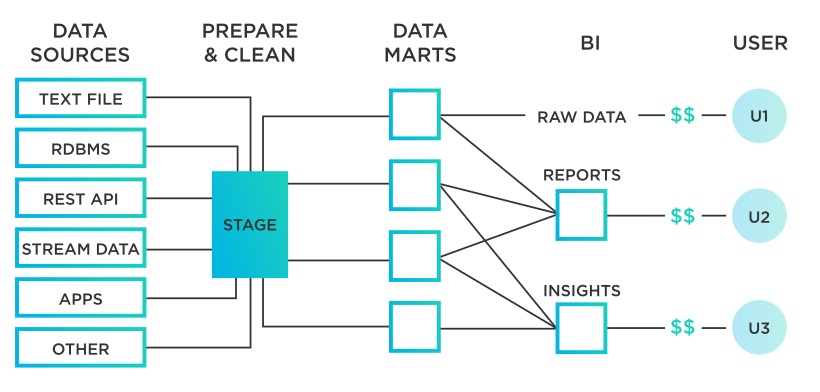
Data union pay refers to the revenue distribution model used by data unions, which are cooperative frameworks that aggregate individual users' data to negotiate collective terms with data buyers. Unlike traditional labor unions that bargain for wages based on physical or intellectual labor, data unions treat personal information as a collective asset. The core mechanism involves bundling anonymized user data to increase bargaining power, allowing participants to secure better compensation than they could achieve through individual, fragmented sales.
This model stands in sharp contrast to standard data brokerage practices. In the conventional data economy, companies collect personal information—such as browsing history, location data, or purchase records—often without explicit consent or fair compensation. Data unions introduce a counterbalance by establishing a structured framework where users retain ownership of their data while pooling it to create a more valuable, standardized dataset. When an enterprise or advertiser purchases access to this aggregated pool, the revenue is distributed among the contributing members, usually on a pro-rata basis relative to their data contribution.
The term "pay" in this context is distinct from traditional employment income. It is not a salary governed by collective bargaining agreements (CBAs) for labor hours, but rather a dividend-like distribution from data licensing fees. The value of this pay fluctuates based on the demand for specific data types, the size of the union, and the quality of the aggregated dataset. Participants are essentially acting as micro-owners of a data cooperative, earning returns from the commercialization of their digital footprint rather than selling their privacy individually.
Calculate your potential earnings
Data union payouts are not fixed salaries. They are variable dividends derived from the aggregate revenue generated by a pool of users selling their data. Your individual share depends on your contribution volume relative to the total pool size and the current market demand for that specific data type.
To estimate your potential monthly income, use the interactive calculator below. It applies a base rate adjusted by a data type multiplier, reflecting the higher value of sensitive or structured data (such as health or financial records) compared to general browsing habits.
How the formula works:
- Base Rate: We assume a conservative base rate of $0.05 per GB of aggregated data, which is typical for general consumer datasets.
- Multiplier: Sensitive data types command higher prices from buyers. The calculator adjusts the base rate by the selected multiplier.
- Result: The estimated payout is the product of your volume, the base rate, and the multiplier.
Important Caveats:
- Pool Variability: This estimate assumes you are part of a mid-sized pool. In larger pools, individual shares may decrease due to dilution.
- Market Fluctuations: Data prices fluctuate based on buyer demand. The rates used here are averages and may not reflect real-time market conditions.
- Platform Fees: Some data unions deduct platform fees (typically 10-20%) before distributing dividends. This calculator shows gross earnings.
For precise projections, consult the specific tokenomics or revenue-sharing model of the data union protocol you intend to join. Official documentation from protocols like Streamr or Ocean Protocol provides detailed breakdowns of their distribution mechanisms.
Compare top data union platforms
Choosing a data union requires evaluating how revenue is distributed, what data is collected, and how privacy is enforced. The landscape is fragmented, with platforms varying significantly in their technical architecture and payout models.
The table below compares leading platforms based on available documentation. Note that "passive income" claims are often speculative; actual payouts depend on data demand and platform liquidity.

| Platform | Payout Model | Data Types | Privacy Features | Min. Payout |
|---|---|---|---|---|
| Ocean Protocol | OCEAN Token | Datasets, AI Models | Zero-knowledge proofs | Variable |
| Hivemind | HIVE Token | Web browsing, App usage | Encryption, Anonymization | 100 HIVE |
| Brave Basic Attention Token | BAT Tokens | Ad attention, Browsing | On-chain privacy | $1.00 USD |
| Streamr | DATA Token | IoT, Market data | Stream-level encryption | 50 DATA |
These platforms operate on different economic incentives. Ocean Protocol focuses on data marketplaces for AI training, while Brave integrates directly into its browser ecosystem. Always review the specific smart contract terms and data usage policies before connecting your wallet.
Privacy and security risks
Data monetization through decentralized unions shifts control from corporations to user collectives, but it introduces specific technical and regulatory hazards. The primary concern is that anonymized data is rarely truly anonymous. Sophisticated re-identification attacks can cross-reference union data with public datasets to reveal individual identities. Once personal patterns are exposed, the financial and reputational damage is often irreversible.
Smart contract vulnerabilities present another high-stakes risk. Since payouts are automated via code, bugs in the contract logic can lead to permanent loss of funds or unauthorized access to data streams. Users must verify that the underlying protocol has undergone rigorous third-party audits. Connecting a wallet to an unaudited or poorly maintained contract exposes your digital identity and assets to immediate exploitation.
Regulatory uncertainty further complicates participation. As of 2026, frameworks like the GDPR in Europe and emerging state laws in the US impose strict rules on data consent and portability. A data union operating in a gray area may face sudden shutdowns or legal penalties, potentially freezing user earnings. Always review the legal jurisdiction and compliance status of the union before contributing data.
High RiskTo understand the potential financial exposure, use the calculator below to estimate your net position after accounting for typical gas fees and platform commissions. This helps separate theoretical revenue from actual take-home value.
Frequently asked questions about data unions
Data union compensation operates differently from traditional employment or standard gig economy platforms. Because these models are relatively new and governed by smart contracts rather than labor laws, the financial and legal implications require careful scrutiny. The following questions address the most common concerns regarding taxation, data rights, and liquidity.
No comments yet. Be the first to share your thoughts!